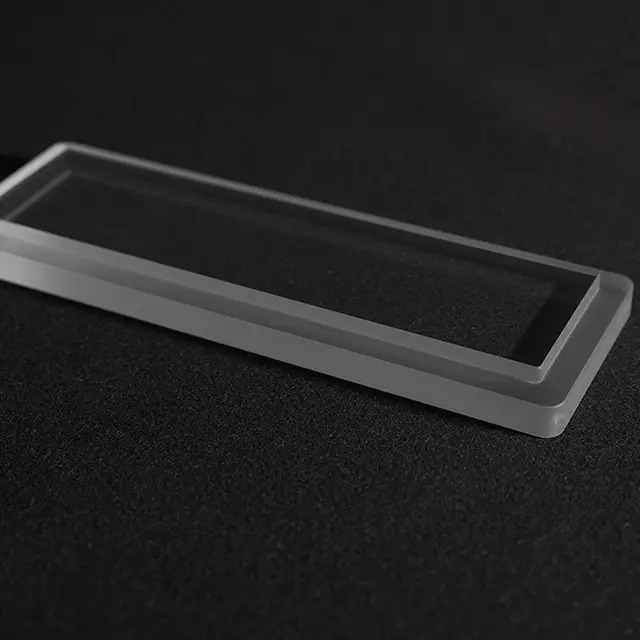
The Critical Role of Heat-Resistant Glass in Modern Lighting
Heat-resistant lamp glass is a cornerstone of industrial and commercial lighting systems, enabling high-intensity illumination while ensuring safety and longevity. As lighting technologies evolve—from quartz halogen lamps to advanced UV-C sterilization systems—the demand for glass that withstands extreme temperatures (300°C–1,200°C) and thermal shocks has surged. Taiyu Glass, a leader in optical glass manufacturing, leverages borosilicate, quartz, and glass-ceramic formulations to solve these challenges. This article explores the science, applications, and innovations shaping this vital material.
1. Material Science: Engineering Glass for Extreme Conditions
1.1 Borosilicate Glass: The Industrial Workhorse
Borosilicate glass dominates heat-resistant applications due to its low thermal expansion coefficient (3.3 × 10⁻⁶/K), achieved by incorporating boron oxide (12–15%) into the silica matrix. This chemistry prevents micro-cracks under rapid temperature shifts, making it ideal for:
1.2 Quartz Glass: Purity for Precision Optics
Fused quartz offers superior thermal stability, softening at ~1,100°C and transmitting UV/IR light efficiently. Key properties include:
UV Transparency: Critical for UV-C germicidal lamps (e.g., hospital sterilization).
Chemical Inertness: Resists acid/alkali corrosion in chemical reactor viewports.
1.3 Glass-Ceramics: The High-Performance Hybrid
Glass-ceramics undergo controlled crystallization to blend glass’s formability with ceramics’ thermal resilience. Examples:
Lithium-Aluminosilicate (LAS): Handles 1,500°C in induction heating systems.
Zero-Expansion Variants: Used in telescope mirrors and semiconductor lithography.
2. Performance Metrics: Beyond Temperature Resistance
2.1 Optical Clarity Under Stress
Heat-resistant glass must maintain >90% transmittance even at 800°C. Taiyu’s ultra-low iron quartz glass achieves 92%+ clarity by reducing iron impurities to <0.01%, preventing the greenish tint common in standard glass.
2.2 Mechanical Durability
Thermal Shock Resistance: Borosilicate survives ΔT of 200°C (e.g., water splashed on hot oven glass).
Surface Hardness: Tempered variants reach 7–9 Mohs hardness (scratch-resistant for mining lamps).
2.3 Safety Fail-Safes
Tempering induces surface compression (10,000–15,000 psi), causing glass to fragment into harmless granules if shattered—a non-negotiable feature for public-space lighting.
3. Cutting-Edge Applications: From Factories to Hospitals
3.1 Industrial Lighting
3.2 Life Sciences and Sterilization
UV-C quartz lamps (254 nm wavelength) inactivate pathogens but generate 400°C+ heat. Taiyu’s high-purity quartz ensures 90% UV transmission while resisting thermal fatigue.
3.3 Aerospace and Defense
Rocket engine test cells use quartz viewports to monitor combustion at 1,200°C, coupled with anti-reflective coatings to reduce glare from exhaust plumes.
4. Customization: Tailoring Solutions for Complex Needs
4.1 Geometric Flexibility
Shape Machining: CNC-cut circles, rectangles, or custom polygons (e.g., hexagonal stage lights).
Thickness Optimization: 2mm for lightweight fixtures vs. 20mm for blast-resistant housings.
4.2 Surface Engineering
Anti-Reflective (AR) Coatings: Magnetron-sputtered layers boost transmittance to 98% and cut reflectivity to <1%. Applications: surgical lights, museum spotlights.
Acid-Etched Frosting: Diffuses light evenly in decorative fixtures while hiding fingerprints.
5. Future Innovations: Smart Glass and Sustainability
5.1 Energy-Efficient Lighting Integration
Photovoltaic-Embedded Glass: Solar-active lamp covers power IoT sensors in smart buildings.
Thermochromic Layers: Auto-tint glass dims lights in response to temperature spikes, reducing cooling loads.
5.2 Eco-Friendly Manufacturing
Taiyu’s closed-loop recycling reclaims 95% of glass waste, while low-melting tellurite glasses (melting point: 700°C vs. 1,600°C for quartz) cut energy use by 40%.
6. Maintenance and Troubleshooting Guide
6.1 Prolonging Lifespan
6.2 Failure Analysis
| Issue | Cause | Solution |
| Cloudiness | Devitrification at 800°C+ | Switch to higher-purity quartz |
| Edge Cracking | Uneven tempering stress | Redesign mounting hardware |
| UV Output Decline | Sodium migration from coatings | Apply barrier interlayers |
FAQ: Heat-Resistant Lamp Glass
1. Can heat-resistant glass be used for LED grow lights?
Yes. Borosilicate lenses withstand 300°C+ from COB LEDs while transmitting photosynthetic wavelengths (400–700 nm). AR coatings boost PAR efficiency by 15%.
2. How does thermal expansion affect lamp design?
Mismatched expansion rates between glass and metal fixtures cause stress fractures. Solution: Use Kovar alloy mounts (expansion matched to borosilicate).
3. Is tempered glass necessary for all high-temperature lamps?
Mandatory for public/industrial settings (safety fragmentation). For enclosed systems (e.g., lab equipment), annealed glass suffices.
4. Can cracked lamp glass be repaired?
No. Micro-cracks compromise structural integrity. Replace immediately.
5. What’s the lead time for custom shapes?
3–4 weeks for CNC machining, polishing, and tempering. Rush services available for thin (<6mm) designs.
 English
 العربية
 Français
 Русский
 Español
 Português
 Deutsch
 italiano
 日本語
日本語 한국어
한국어 Nederlands
 Tiếng Việt
 ไทย
ไทย Polski
 Türkçe
 አማርኛ
አማርኛ ພາສາລາວ
 ភាសាខ្មែរ
 Bahasa Melayu
 ဗမာစာ
ဗမာစာ தமிழ்
தமிழ் Filipino
 Bahasa Indonesia
 magyar
 Română
 Čeština
 Монгол
 қазақ
қазақ Српски
 हिन्दी
 فارسی
فارسی Kiswahili
 Slovenčina
 Slovenščina
 Norsk
Norsk Svenska
 українська
 Ελληνικά
 Suomi
Suomi Հայերեն
 עברית
עברית Latine
 Dansk
Dansk اردو
اردو Shqip
Shqip বাংলা
বাংলা Hrvatski
 Afrikaans
 Gaeilge
 Eesti keel
 Māori
Māori


