In complex, multi-element high-definition imaging systems, raw sensor resolution fundamentally relies on maximum optical throughput. If your lenses cannot pass light efficiently, the most advanced digital sensors become practically useless. Without intervention, every glass-to-air interface reflects approximately 4% of incident light due to Fresnel reflection. In a system utilizing multiple lenses, this compounding math leads to catastrophic signal loss.
Integrating precise optical coatings is not a superficial upgrade; it is an engineering requirement to maximize Signal-to-Noise Ratio (SNR), eliminate ghosting, and stabilize imaging performance across varied environments. We will explore the underlying physics of thin-film interference. You will learn how to compare solution categories based on spectral bandwidth. Finally, we will outline critical metrology metrics you need for rigorous quality assurance.
Key Takeaways
Uncoated optical surfaces cause compounding transmission losses (down to ~92% for basic glass), significantly degrading the SNR of high-def camera modules.
Choosing between Broadband Anti-Reflection (BBAR) and V-coats depends strictly on the system's spectral bandwidth and required damage thresholds.
Modern AR optical coatings stack functional layers—including hardcoats and hydrophobic/oleophobic barriers—without disrupting the destructive interference required for peak transmittance (often achieving ≥98.5%).
Evaluating a coating vendor requires rigorous metrology data, including UV-Vis spectrophotometry and thermal cycling stress tests, to ensure long-term durability.
The Technical and Commercial Impact of Uncoated Optics
Engineers often face a difficult mathematical reality when designing multi-element optical paths. Fresnel reflections naturally occur whenever light travels between mediums possessing different refractive indices. Common applications like machine vision lenses, medical endoscopes, and aerospace sensors utilize multiple glass elements. This creates numerous glass-to-air boundaries. If left untreated, the performance degradation scales exponentially.
Throughput and SNR Degradation
Uncontrolled surface reflections actively reduce light transmission. Consider a standard five-element camera lens array. It contains ten distinct glass-to-air surfaces. Losing 4% of light at each boundary drops the total system transmittance to roughly 66%. This massive light reduction directly forces imaging sensors to operate at higher ISO levels. Higher ISO settings invariably introduce digital noise. This noise sharply degrades low-light performance and destroys micro-contrast. Automated systems require high Signal-to-Noise Ratios (SNR) to function reliably. You cannot afford to lose a third of your incoming light.
Ghosting and Stray Light Anomalies
Beyond simple light loss, uncoated optics create destructive optical artifacts. Back-reflections bounce endlessly between internal lens elements. These stray light waves hit the digital sensor at unintended angles. They create ghost images, flare, and false signals.
This presents critical failure points across several industries. We see this impact most severely in:
Automated Optical Inspection (AOI): False light signals trick inspection software into identifying non-existent defects.
Precision Laser Targeting: Stray reflections misdirect energy, causing targeting errors or internal thermal damage.
Automotive LiDAR: Glare from oncoming headlights overwhelms uncoated optical receivers, blinding the vehicle's navigation system.
To avoid these catastrophic anomalies, you must specify appropriate surface treatments early in the design phase.
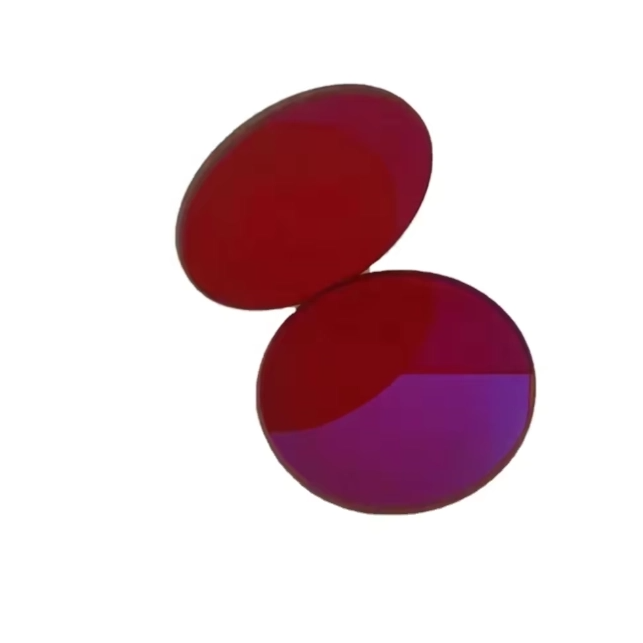
Core Mechanisms Behind AR Optical Coatings
To mitigate Fresnel losses, manufacturers apply specialized thin films. Understanding the underlying physics helps you specify the correct ar optical coatings for your project.
Destructive Interference (The Physics)
Antireflective layers operate on the principle of destructive interference. Manufacturers deposit thin films at precise thicknesses. Engineers typically target odd multiples of a quarter design wavelength. When light hits the coated lens, it reflects off both the top and bottom boundaries of the thin film. Because the film is exactly one-quarter wavelength thick, the two reflected waves travel paths differing by half a wavelength. This creates a 180° phase shift. The peaks of one wave align perfectly against the troughs of the other. Consequently, they cancel each other out, allowing the light to transmit through the lens rather than bouncing back.
Refractive Index Matching
Finding the correct material is equally important as determining the thickness. The ideal coating refractive index represents the geometric mean of the incident medium (usually air) and the substrate (the glass). In a perfect theoretical model, you calculate this using a straightforward equation. If the glass has an index of 1.52, the ideal coating index sits around 1.23. Since few durable materials naturally possess this exact index, engineers use multi-layer stacks. These stacks simulate the required refractive properties through alternating high and low index materials.
Advanced Topographies
Standard interference layers handle most applications well. However, extreme scenarios require advanced topographies. Researchers actively develop biomimetic approaches. The "Moth-eye" structure is a prime example. It uses sub-wavelength hexagonal nanostructures to create a gradual transition between the air and the glass. This entirely eliminates sharp refractive index jumps. Additionally, graded-index (GRIN) layers offer specialized alternatives. GRIN layers gradually change their refractive index throughout the material thickness. They provide exceptional performance for extreme broadband requirements or high-angle use cases where traditional layers fail.
Solution Categories: Matching the Coating to the System
Selecting the right coating stack dictates your final system performance. You must match the coating design to your operational waveband and environmental constraints.
V-Coats (Narrowband AR)
V-coats are highly specialized narrowband solutions. They serve single-frequency laser systems and highly controlled narrowband environments. Their transmission profile looks like a sharp "V" on a spectral graph. They achieve near-zero reflectance, often dropping below 0.2% at a specific Design Wavelength (DWL). While their performance is unmatched at the target wavelength, they reflect significantly more light outside this narrow band.
Broadband Anti-Reflection (BBAR)
Broadband Anti-Reflection (BBAR) solutions are essential for standard high-definition imaging. They cover wide spectral ranges like VIS, VIS-NIR, or UV-AR. BBAR trades absolute peak performance at one specific wavelength for uniform, consistent transmission across an entire band. You need BBAR when developing full-color camera modules or multi-spectral sensor arrays.
Deposition Methods: PVD vs. ALD
How the manufacturer applies the coating matters just as much as the material used.
Physical Vapor Deposition (PVD): PVD remains the industry standard. It works exceptionally well for flat windows, cover glass, and standard spherical lenses. However, it relies on line-of-sight deposition. This causes uneven thicknesses on steep curves.
Atomic Layer Deposition (ALD): ALD is the necessary approach for complex 3D micro-optics and strongly curved domes. ALD deposits materials one atomic layer at a time. This guarantees conformal, uniform coating thickness across complex geometries. It prevents the severe performance drop-offs often seen at the edges of PVD-coated curved lenses.
| | | Table 1: Comparison of Coating Categories and Deposition Methods |
Solution Type | Best Application | Reflectance Profile | Recommended Deposition |
V-Coat | Single-frequency lasers | <0.2% at exact Design Wavelength | PVD |
BBAR | Multi-spectral / HD cameras | ≤0.5% average across wide band | PVD |
Conformal AR | 3D micro-optics, steep domes | Uniform across steep angles | ALD |
Key Evaluation Metrics for Procurement and R&D
Engineers must establish rigid performance criteria before purchasing optical coatings. Subjective visual checks do not suffice. You need empirical metrics to secure system longevity.
Transmittance and Average Reflectance ($R_{avg}$)
You must define baseline expectations for enterprise-grade components. Do not accept vague promises of "high transmission." Specify exact figures. Average reflectance ($R_{avg}$) should measure ≤0.5% per treated surface. Meanwhile, your total system transmittance should reliably exceed 98.5%. Holding vendors to these strict numerical standards eliminates substandard suppliers from your procurement pipeline.
Angle of Incidence (AOI) Stability
Light rarely hits a lens perfectly straight on. You must address the performance shift when light hits the lens at an angle. Angle of Incidence (AOI) heavily influences thin-film behavior. As the angle increases, light travels a longer path through the thin film. This shifts the destructive interference to a different wavelength. Wide-angle camera modules demand AR stability from 0° up to 45°. If you ignore AOI parameters, your optical system will suffer distinct color shifts and light loss at the image edges.
Composite Durability Layers
Modern AR stacks combine optical transmission layers with physical protection. Delicate interference layers cannot survive harsh field conditions alone. Manufacturers integrate composite durability layers to extend operational life.
Hardcoats: These provide crucial scratch resistance. They protect exposed elements like the sensor cover glass from mechanical damage during cleaning.
Hydrophobic/Oleophobic Layers: These outermost barriers actively repel moisture, oils, and fingerprints. Crucially, they achieve this without altering the system's delicate refractive index.
| | Chart: Target Metrics for Enterprise-Grade Procurement |
Metric Category | Target Specification | Primary Benefit |
System Transmittance | ≥ 98.5% | Maximizes SNR and low-light capability |
Average Reflectance ($R_{avg}$) | ≤ 0.5% per surface | Eliminates ghosting and stray light |
AOI Stability | 0° to 45° uniformity | Prevents edge-color shifting in wide lenses |
Surface Durability | MIL-SPEC compliant | Ensures lifespan in extreme environments |
Best Practices for Procurement
Always specify your exact operational waveband and environmental constraints upfront. Demand prototype testing before committing to high-volume production. Clearly communicate your maximum acceptable AOI.
Common Mistakes
Many procurement teams request "standard AR" without defining their specific laser damage threshold (LDT) or humidity requirements. This oversight routinely leads to field failures when optical elements burn or delaminate under real-world stress.
Implementation Risks and Quality Assurance
Moving from design to deployment carries inherent risks. R&D teams must anticipate manufacturing defects and environmental vulnerabilities.
Stress-Induced Optical Deformation
Thin-film deposition can introduce severe mechanical stress. Materials naturally expand and contract at different rates. When manufacturers bond multiple distinct layers onto a substrate, it generates tensile or compressive stress. On robust glass blocks, this stress matters very little. However, on delicate polymer substrates or ultra-thin micro-lenses, this stress can physically warp the optic. This unintentional deformation alters the focal length or physical geometry of the lens. You must closely monitor component curvature before and after the deposition process.
Metrology and Verification
Never accept theoretical performance curves from your vendors. Theoretical software models always look perfect. You must demand empirical testing data derived from actual production runs.
Spectrophotometry: Use this to verify exact transmission profiles across your target waveband. It provides the core proof of light throughput.
Laser Reflectometry or Cavity Ring-Down: Standard spectrophotometers struggle to measure extremely low reflections. For high-stakes laser applications, use cavity ring-down testing. It validates sub-0.1% reflectance with parts-per-million accuracy.
Environmental Stress Testing: Optical components must survive the real world. Verify adherence against MIL-SPEC standards for aggressive temperature cycling, salt fog, and extreme humidity.
Conclusion
Specifying precise optical coatings remains a structural system decision, not an afterthought. The right application secures image contrast, ensures structural longevity, and maximizes sensor efficiency. Without these engineered thin films, compounding signal loss destroys the potential of high-definition sensors. You must view surface treatments as critical components of the optical path.
Before requesting custom prototyping or off-the-shelf component evaluation from manufacturers, define your parameters clearly. Document your exact operational waveband. Calculate your maximum Angle of Incidence. Detail your environmental durability constraints. Taking these proactive steps ensures your imaging systems perform flawlessly from day one.
FAQ
Q: What is the difference between an AR coating and a polarizing filter?
A: Polarizing filters block specific light orientations from external sources, effectively reducing surface glare from water or glass. Conversely, AR coatings eliminate internal reflections within the lens system itself. They use destructive interference to pass more light through the glass. Engineers frequently use both technologies together for maximum clarity.
Q: Do AR coatings lower the laser damage threshold (LDT) of an optic?
A: It depends on the specific design. Specific high-power coatings, like specialized V-coats, are engineered to withstand massive laser fluences. However, an improperly matched broadband layer will quickly absorb heat and burn. You must explicitly specify your required LDT during the procurement phase.
Q: Why is my AR-coated lens experiencing a color shift at the edges?
A: A high Angle of Incidence (AOI) changes the effective optical thickness of the applied layers. Light traveling through the film at an angle shifts the destructive interference to a different wavelength. This shift often appears blue or purple at the lens edges. Proper wide-angle design mitigates this.
Q: How does coating thickness impact 3D or strongly curved optical elements?
A: Standard line-of-sight deposition methods, like PVD, naturally result in thinner layers on steep optical curves. This alters spectral performance across the curve. Conformal methods like Atomic Layer Deposition (ALD) are required to maintain exact nanometer thickness across complex geometries.
 English
 العربية
 Français
 Русский
 Español
 Português
 Deutsch
 italiano
 日本語
日本語 한국어
한국어 Nederlands
 Tiếng Việt
 ไทย
ไทย Polski
 Türkçe
 አማርኛ
አማርኛ ພາສາລາວ
 ភាសាខ្មែរ
 Bahasa Melayu
 ဗမာစာ
ဗမာစာ தமிழ்
தமிழ் Filipino
 Bahasa Indonesia
 magyar
 Română
 Čeština
 Монгол
 қазақ
қазақ Српски
 हिन्दी
 فارسی
فارسی Kiswahili
 Slovenčina
 Slovenščina
 Norsk
Norsk Svenska
 українська
 Ελληνικά
 Suomi
Suomi Հայերեն
 עברית
עברית Latine
 Dansk
Dansk اردو
اردو Shqip
Shqip বাংলা
বাংলা Hrvatski
 Afrikaans
 Gaeilge
 Eesti keel
 Māori
Māori


